

The problem: Google couldn't read the site
The site was built with AI, on Base44. In the browser it looked complete, but Google and AI search engines couldn't read it properly. It could have the best offer and zero SEO potential.
The diagnosis: three tests, from the simplest to the most technical
The simplest: searching site:regresoempresarial.com on Google. No page showed up: if Google shows nothing, it isn't reading the site, and neither is an AI. Try the test on yours.
The most obvious: the site wasn't in Google Search Console. There was no way to measure which pages made it into Google, or to send it the sitemap.
The most technical: a Screaming Frog crawl. It found repeated titles and canonicals (the address each page declares as its official one) all pointing to the home page. Also, pages that couldn't be indexed and text Google couldn't reach.
The same title at all 19 addresses (curl, Aug 18, 2026)24 to 35 words per page (Screaming Frog without JavaScript, Jul 18, 2026)
Each page's own title, its H1 and the structured data1,674 words on the home page
The fix: Google gets every page complete
How a page reaches Google
Before
Google requests the page
Base44
draws it with JavaScript, in the browser
An empty box
24 to 35 words per page
After
Google requests the page
Cloudflare Worker
real 301s and 404s, clean sitemap
Base44 with prerender
the HTML already built at publish time
The full page
1,674 words on the home page
Measurement: I registered the site in Search Console and sent it the sitemap.
The code on GitHub, with access for Claude Code, an AI agent that writes code. Each fix was researched in the official documentation first.
Prerender: every page is published with its HTML already built, so Google doesn't need to run JavaScript to read it.
A Cloudflare Worker (a small program in front of the site) with real redirects and 404 errors.
18 technical recommendations, ranked by impact, confidence and ease; 16 already applied. They're in the technical audit (spreadsheet).
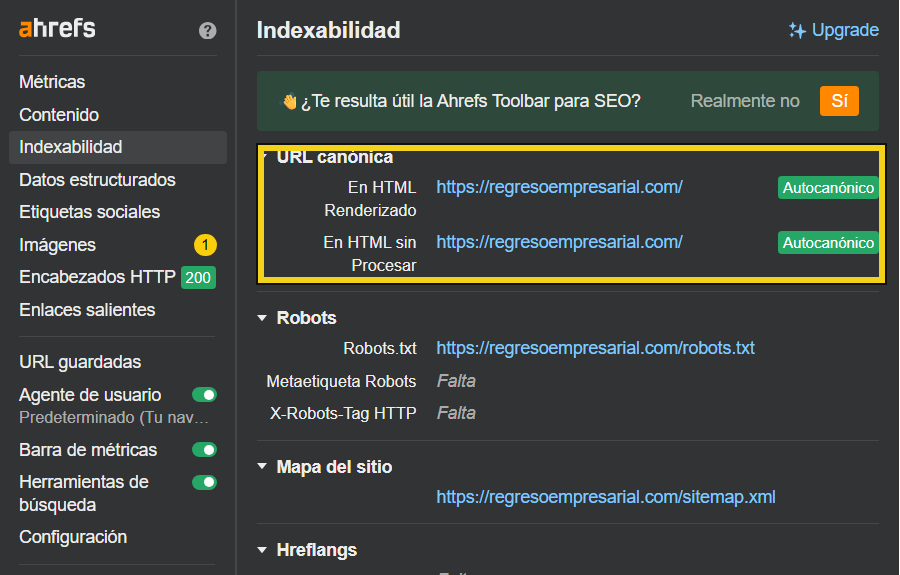
Own canonical, with and without JavaScript
Ahrefs toolbar · regresoempresarial.com home page, Oct 15, 2026.
The two versions matching proves Google doesn't need to run JavaScript to know what to index.
I added the yellow box.
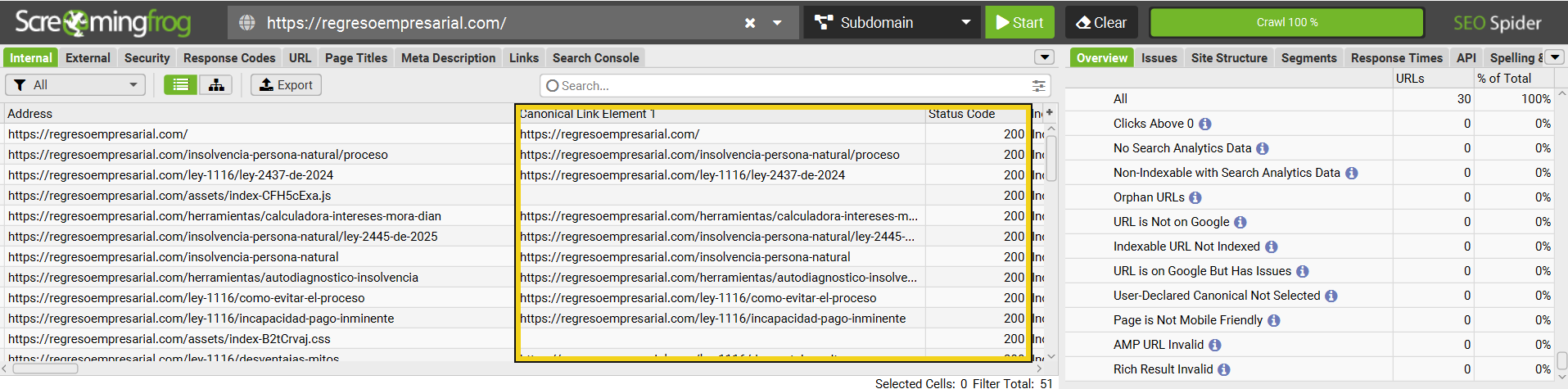
Every page: 200 and its own canonical
Screaming Frog · full crawl on Oct 15, 2026, 129 resources.
Each problem and how it was solved is in the technical review (spreadsheet, in Spanish).
I added the yellow box.
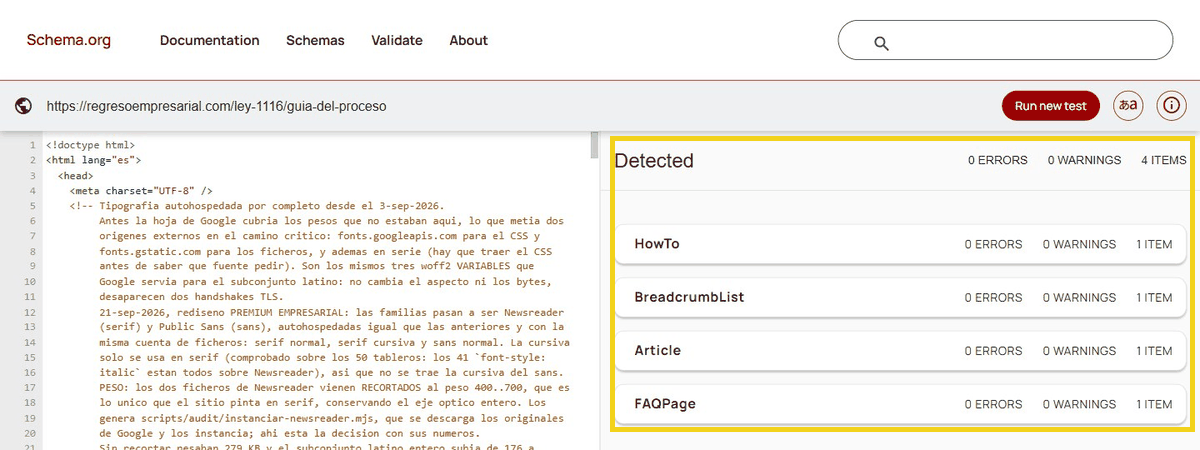
4 structured data types · 0 errors · 0 warnings
Schema.org validator · the Law 1116 process guide, Oct 31, 2026. On the left, the HTML the validator received from the server.
Google gets what each page is right in the HTML: a step-by-step guide, its FAQs and its place in the site. Before the prerender, that HTML arrived empty.
I added the yellow box.
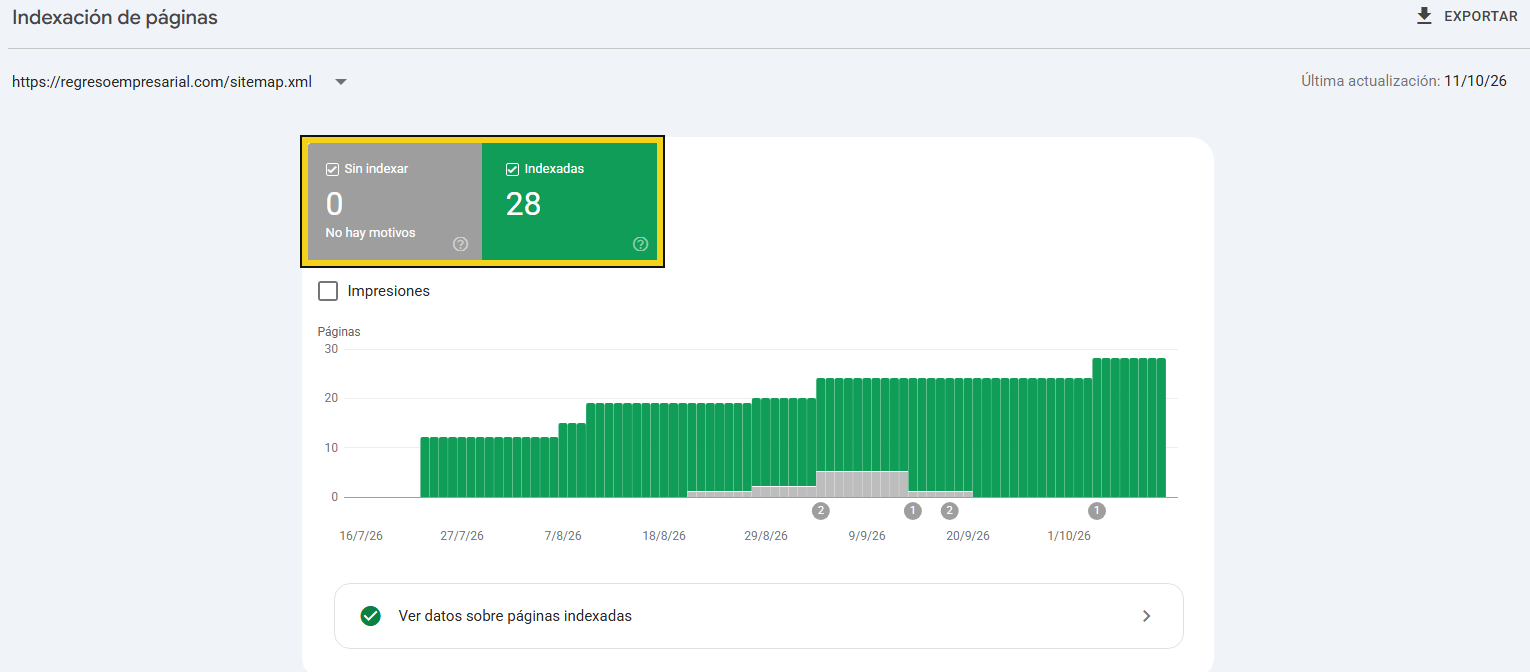
The result: 28 of 28 pages in Google, and a better position
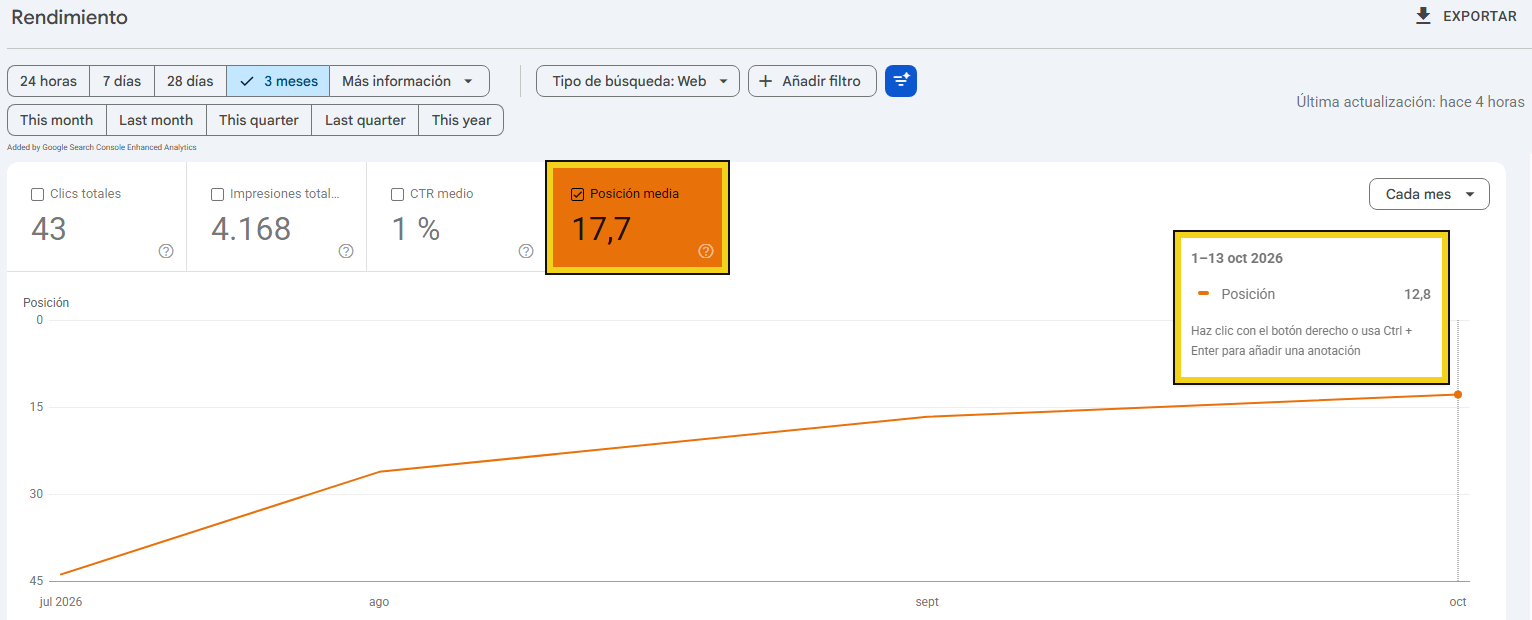
Average position: over 40 in July → 12.8 in October
Search Console · three months, average position by month; 12.8 on Oct 1–13, 2026. Screenshot of Oct 15, 2026.
It's an average across all searches: it improves when the site shows up higher, and also when it stops showing for distant searches. That's why case 2 reads it page by page.
I added the yellow box.
Before asking how to rank in AI Overviews, you need to know whether Google and AI can see the site. Once the site is visible, the first data from potential clients arrives. That's what you use to work on architecture and content (case 2), to add other channels (case 3) and to design a landing page that filters clients (case 4).
Next steps: security and real-user speed
Switch the CSP (the rule that says which code may run on the site) to blocking mode: today it only reports (T-15 in the audit).
Measure Core Web Vitals with real users once traffic is enough for Chrome's report; on Oct 15, 2026 it wasn't yet.