SEO vs SEM: the difference, and when to use each
By Carlos Alberto Cardona B.· 9 min read

SEO vs SEM comes down to how the visit arrives. SEO earns it in Google's organic results, without paying per click. SEM, in its everyday sense, buys it with search ads such as Google Ads.
The essentials
- What it is
- SEO is showing up in Google's organic results without paying per click. SEM, as most people use the word, is paying for ads on the search engine.
- Why it matters to you
- SEO takes months and keeps working after you stop investing; paid search brings visits from day one and stops with the campaign. Choose wrong and you pay for clicks organic could have brought, or wait months for a lead you needed today.
- What to do today
- Decide how long you can wait for your next client. Before spending on either, set up GA4 to keep organic and paid apart.
Deciding where this quarter's budget goes? So am I, in my family's business: after 12 days and 146 Google Ads clicks, I still don't know which channel converts better. Meanwhile, my own site is still at the stage where I put in more work than I get back.
SEO can take months to show results and doesn't switch off the day you stop investing. SEM can bring visits from day one, but every click costs money and the ads disappear when you pause the campaign. If you run a service business that can afford some ads, the sensible move is usually both, measured separately.
One thing holds either way: Google says no one can buy better placement in organic Search results. Running ads won't lift your SEO.
What's the difference between SEO and SEM?
The difference between SEO and SEM starts with the words. SEO stands for search engine optimization; Google says it's about helping search engines understand your content. In practice, it means working on your site so Google can read it and each page answers a specific search.
SEM stands for search engine marketing. In everyday use it means paid search, or PPC (pay-per-click): ads that appear on Google when someone searches. In Google Ads, every eligible ad enters an auction that decides whether and where it shows, based on your bid, ad quality and other factors.
With cost-per-click bidding, you pay for each click on your ad. Both appear on the same results page, but apart: Google says ads are clearly labeled.
SEO vs SEM, side by side
| Question | SEO | SEM (paid search) |
|---|---|---|
| Where it shows | In Google's organic results | In the ad sections, labeled as ads |
| How you pay | With work on your site and content; no cost per click | For each click on the ad, with cost-per-click bidding |
| How long it takes | According to Google, some changes take hours and others several months | The ad enters the auction for each search as soon as the campaign is live |
| What happens if you stop investing | What Google already stored stays, though Google doesn't guarantee it keeps showing it | Pausing the campaign stops its ads from showing |
| What you control | The content and the technical side; Google decides the ranking | The bid, the budget, the keywords and the ad copy |
| How you measure it | Search Console (what happened on Google) and GA4 (what people did on your site) | Google Ads (clicks and cost) and GA4 (what people did on your site) |
Whether you frame it as SEM vs SEO or the other way around, no column wins on everything. Paid search buys time; SEO builds a channel that keeps bringing visits without paying for each one.
It's the same idea I use to explain AI SEO: ads are rent, SEO is a home you own. The sensible move is usually to pay rent while you build.
Is SEO part of SEM? The two meanings of the word
It depends on who's writing. In everyday use, and in this article, SEM means search advertising, such as Google Ads. In the broad sense, SEM covers all search engine marketing, and SEO sits inside it as the organic part.
That's why two articles on SEO and SEM can seem to contradict each other while agreeing on the facts. When someone pitches you “an SEM strategy,” ask which meaning they have in mind. The first is paid ads; the second is ads and SEO together.
Do Google Ads help your SEO?
No: running ads doesn't lift your site in the organic results. Google says it in writing on the page where it explains its ads: no one can buy better placement in organic Search results. Advertisers aren't given special advantages or ranking boosts either.
It repeats it in its in-depth guide to how Google Search works: Google doesn't accept payment to crawl a site more frequently or rank it higher. If someone sells you ads as a shortcut to SEO, ask them for their source.
When should you use each one?
The deciding question is how long you can wait for your next client. Budget comes second, and third, whether Google can already read your site. If you need leads this month, ads; if you can wait months, SEO; if you need both, run both, measured separately.
When to start with SEO
You can wait months for the first leads from Google. Google warns that some changes take effect in a few hours and others could take several months.
You don't have the budget to pay for every click month after month.
Your clients research before they hire: questions, comparisons, “how to.”
I wrote this while studying philosophy, about why I chose that field (my translation): “I just wanted to get into a practice that would require a long-term commitment on my part.” SEO asks for the same.
Before you invest, take a baseline snapshot in Search Console. Without it, in three months you won't know what changed. And if your site doesn't show up on Google at all, start with the seven causes: that isn't a channel problem.
If your business serves one city, start with what's free. Your Google Business Profile is your listing on Google Maps, and it doesn't charge per click.
When to start with paid search
You need leads this month and the business can't wait.
You're launching a new service and want to learn quickly which searches bring clients.
You can pay for every click and measure what happens after it.
Paid search gives you data sooner: which searches bring leads. That guides the content you later write for SEO. But the day you switch it off, it's gone: pausing a campaign stops its ads from showing.
When to run SEO and SEM together
When you need leads today and also want to stop depending on ads. Paid search keeps the business going while SEO grows, and each channel is judged against its own target.
Here, more is more. Alex Hormozi summed it up in the title of a podcast episode: “Volume negates luck”.
Two measured channels give you more attempts and more data than one. Paid search tells you which searches sell; SEO turns them into pages that stay up when you switch the campaign off.
In the case below, informational searches (the “what is” and “requirements” kind) took 41.7% of the visible spend in 12 days. Those searches ask for an explanation, and an explanation is SEO content. Paid search is already telling me what to write.
The condition is measuring them separately from day one. Otherwise, three months in you'll have one lead count and no way to know which channel brought it. For a second opinion before deciding, give this to your AI assistant:
I run a [service] business in [city and country]. I want to decide whether to start with SEO, with Google Ads or with both. Here's what I know:- My site: [address]- Do I need leads this month, or can I wait several months?: [ ]- What I can spend on ads each month without putting the business at risk: [amount, or “nothing for now”]- Does Google show my site already? Result of site:my-domain.com and, if I have Search Console, impressions for the last three months: [ ]- Do I track leads in GA4 with organic and paid kept apart?: [yes / no / not sure]Open my site and tell me which channel you'd start with and why, using only what you see and what I told you.Rules: quote the exact text on my page your answer relies on. If you couldn't open the page, say so and don't describe it. Mark anything you can't see from a browser as “not verifiable.” Don't make up costs per click, search volumes or timelines, and don't promise rankings. If you need more information to decide, tell me what's missing.
A real case: SEO and paid search at the same time for a service business
On regresoempresarial.com, an insolvency consultancy in Bogotá and a family business, I run SEO and SEM side by side. The site was already getting its first organic visits, but there was no plan to turn them into clients. I added two Google Ads campaigns with their own landing pages and set up GA4 to keep organic visits apart from paid ones.
From October 8 to 14, 2026, paid search brought 79 clicks from 930 impressions (Google Ads, screenshot of Oct 15, 2026). The average cost per click was 619 Colombian pesos: the cost for that industry that week, and yours will be different.
On October 15, 2026, before optimizing, I set a target for each channel, 2 conversions per 250 clicks, with a first review at 100 clicks. I'll review the results in late November 2026, so today I can't tell you which channel converts better. The full SEO and Google Ads case study covers what I did, with the screenshots.
The week above was the first snapshot. On October 18, 2026, I read the next stage, the first review: 12 days of these October campaigns, already past 100 clicks.
| What I measured | Figure | Tool and window |
|---|---|---|
| Paid clicks and average cost per click | 146 clicks, at 537 Colombian pesos | Google Ads, 12 days from Oct 6, 2026 |
| Paid conversions | 2; each one a click on the WhatsApp button, with a value of 0 | Google Ads, same window |
| Spend on informational searches (“what is,” “requirements”) | 41.7% of the visible spend | Google Ads, same window; 49% of clicks came from terms Google Ads doesn't show |
| Average session duration | Organic, 301 seconds; paid, 104 | GA4, Sep 18 to Oct 17, 2026 |
| Organic key events | 0 | GA4, same window |
Two conversions aren't two clients, because Google Ads counted a click on the WhatsApp button as a conversion. And organic brings visits that stay almost three times as long, but don't message yet in the same visit.
How do you measure SEO and SEM without mixing them?
With a separate tool for each channel and a third one that brings them together. Search Console measures organic; Google Ads, paid; and GA4, what people do once they reach your site, by source and medium. Here's each one:
Organic, in the Search Console Performance report: clicks and impressions from Google Search results.
Paid, in Google Ads: clicks, impressions and cost for each campaign.
What people do once they arrive, in GA4, by source and medium. An organic visit from Google and a paid one show up as different pairs.
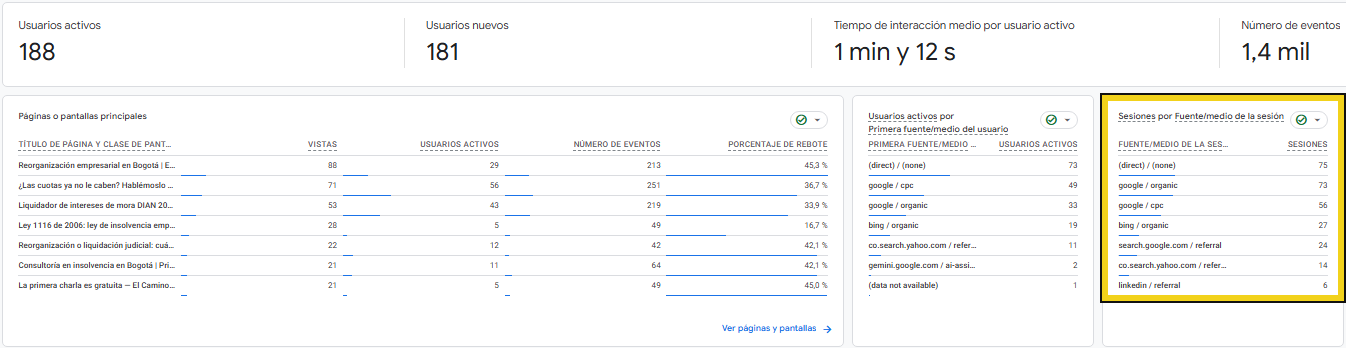
Organic and paid, each in its own row
Google Analytics 4 · screenshot of Oct 14, 2026: organic and paid, each in its own row.
That way each channel gets optimized with its own data.
I added the yellow box.
How to set GA4 up so this works, and why a click is not a contact, is in the Google Analytics 4 guide. Here, the rule is enough: never fold both channels into one number.
Paying for ads and not sure what brings you clients?
If you've paid for ads for months and don't know how many leads they bring, choosing between SEO and SEM comes later. The same goes if your site doesn't show up on Google and ads are your only way in. First you need to know what's happening today.
In the free diagnostic I review the public side of your site and tell you which serious errors are costing you visibility. You get it in writing, within two business days, with no sales call.
If you need more after that, the technical SEO audit tells you what Google receives from your site and in what order to fix it. The 90-day SEO strategy decides what to publish, so organic starts carrying what you pay for in ads today.
Don't have a page to send those clicks to yet? My SEO website design has a fixed price and includes GA4 and Search Console in your name.
Still selling only on social media? Here I explain whether you need a website if you already sell on Instagram.
Frequently asked questions
It depends on who's using the word. In everyday use, SEM means search advertising, such as Google Ads; in the broad sense, it includes SEO too. This article uses the first meaning.
Neither in the abstract: in SEM vs SEO, what decides is how long you can wait. Paid search fits if you need leads now; SEO, if you can wait months. With some budget, the sensible move is usually both, measured separately.
Google says some SEO changes take hours and others several months, with no fixed timeline. An ad enters the auction for each search as soon as the campaign is live.
The auction decides, so it changes with the industry, the city and the week. The average click in this article's case cost 619 Colombian pesos from October 8 to 14, 2026, and 537 over its first 12 days. For “seo website design” in the US, Dinorank estimates $66.86 per click (Oct 17, 2026).
Yes, and it's what I do in the case in this article. The condition is measuring each channel with its own tool and setting it a target before optimizing.
No. Google says no one can buy better placement in organic Search results. Advertisers aren't given ranking boosts either.
Sources
Article reviewed on October 18, 2026. Each date is the source's last published update.
See the 9 sources
- 01How ads work on Google Search · Google
- 02In-depth guide to how Google Search works · Google Search CentralDecember 18, 2025
- 03Search Engine Optimization (SEO) Starter Guide · Google Search CentralDecember 10, 2025
- 04Auction · Google Ads Help
- 05Cost-per-click (CPC): Definition · Google Ads Help
- 06Enable, pause, or remove a campaign · Google Ads Help
- 07Performance report (Search results): Overview and basic setup · Search Console Help
- 08Scopes of traffic-source dimensions · Analytics Help
- 09The Game, ep. 266: “Volume negates luck” · Alex HormoziJanuary 12, 2021
About the author. Carlos Alberto Cardona B., SEO specialist in Bogotá. I write what I measure, with every number next to its instrument and date, and I verify what AI executes myself.